Search This Blog

Thursday, June 7, 2018

Ordinary Life or Extraordinary Life?

I heard American author Elizabeth Gilbert say in a 2017 interview,

about a decade after writing one of the most well known (if not the most well-known) travel books by a woman or a man, that most activities in our lives are probably 90% boring.
Which is to say, mundane, repetitive, predictable, and quite ordinary.

We brush our teeth, fill the coffee maker, commute to work, tell our children to wash their hands and put on their bike helmets.  We sit in meetings at work, pay the electric bill online, and lock our cars.
We do these things again.  And again.  And again.   There’s that 90%.

But then I think about the other 10%.
This morning, as I put my 4 year-old daughter into her car seat before the sun had risen, I briefly closed my eyes and pressed my forehead gently against her forehead.

As I felt the heat of her skin on mine, and the curls of her light brown hair lightly touching my face, my heart spontaneously contracted, and my love for her felt wider than the entire universe.
And in that moment, I realized, we do these things too.  Over and over again.  And that’s the 10% extraordinary in our lives.

In American poet Mary Oliver’s
2004 book, Why I Wake Early, she writes in her poem “Mindful”:

Every day
I see or I hear
something
that more or less
kills me with delight,
that leaves me
like a needle
in the haystack
of light.
It is what I was born for-
to look, to listen,
to lose myself
inside this soft world-
to instruct myself
over and over
in joy,
and acclamation.

You see, it is not until we zoom in to the very moment of our lives in the very moment that we are living it, like a telephoto lens of a camera, that we fully experience the extraordinary of life.

And yet, now here comes the paradox, it is only when we do this, when we practice living one-mindfully, that we realize that the other 90% which is undeniably mundane, repetitive, predictable, and ordinary, is actually extraordinary too.

Perhaps that is why Swiss psychiatrist and psychoanalyst Carl Jung


famously wrote:
Only a paradox comes close to comprehending the fullness of life.

Or why American poet Walt Whitman


declared in Song of Myself:
Do I contradict myself? Very well, then, I contradict myself; I am large -- I contain multitudes.

Ordinary and extraordinary. There is truth in both.
I will close with another poem entitled “This World” from Ms. Oliver’s same book Why I Wake Early, in which she writes:

I would like to write a poem about the world that has in it
nothing fancy.
But it seems impossible.
Whatever the subject, the morning sun
glimmers it.
The tulip feels the heat and flaps its petals open
and becomes a star.
So maybe, come to think of it, perhaps there is no 90% ordinary and 10% extraordinary because in the end, or maybe it's actually in the beginning, it is all just one.

Wednesday, June 6, 2018

Poetry 130: New Growth

New Growth

A piece of me is 
dying. 

I hope it is an
unnecessary limb.

A dead branch. 
A brown leaf.
Something now
obsolete. 

Why then,
does it pain 
me so?

The severing. 
The loss. 
Becoming
untethered from 
that which 
no longer
serves me. 

I carry a lump
at the back 
of my throat;
feeling bereaved
for what was 
my core-
for that 
which felt so 
essential just 
yesterday. 

Change is inevitable. 
Transformation is
radical. 

Will I dare 
to be radical?

Or will I wither
like Langston’s
raisin 
in the sun?

I carry sympathy 
in my heart
for the 
infant green growth 
pushing through
the earth outside 
my door. 

How hard
it can be
to be born.

-Me

Saturday, May 19, 2018

Labyrinth as Metaphor for a Non-Linear Life

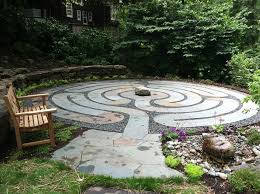
About one week ago, while walking a labyrinth with a group of strangers, I was reminded that the spiritual life is not a linear path.

I must confess, this reminder was met with pretty intense frustration.

For those of you who have never had the opportunity to walk a labyrinth, imagine it as an outdoor or indoor design that looks something like the images below.


About 25 years ago in the United States it might have been quite difficult to locate a labyrinth in your nearby community.

However, nowadays labyrinths can be found in abundance in both more traditionally "spiritual" spaces like a church or a spiritual retreat center, but also in purely secular places like hospitals, public parks, and even prisons.

This growth in interest and construction of labyrinths in the United States has led some people to name it a "Labyrinth Renaissance" because labyrinths are of course not a new phenomenon as they date back thousands of years.

Traditionally, labyrinths have been used as spiritual tools.

For example, during Medieval times in Europe, an individual who wished to make a religious pilgrimage to the Middle East but was unable to, might use a labyrinth that was built into the floor of a cathedral as a metaphor for the actual religious pilgrimage there were unable to make.

Nowadays, many consider the act of walking a labyrinth to be another form of contemplative practice that may feel like prayer and/or meditation.

My first experience walking a labyrinth was about ten years ago at Kripalu Center for Yoga and Health in the Berkshires when I was 30 years-old.

Since then, I have gone into some of the literature about labyrinths to understand its purpose and possibility for my spiritual life.

For example, Dr. Lauren Artress who wrote the 1995 book Walking A Sacred Path: Rediscovering the Labyrinth as a Spiritual Tool, wrote this about the potential spiritual (and I would argue psychological) usefulness of a labyrinth:


The winding path of the labyrinth offers a blueprint for the psyche to meet the soul.

This is a bold statement to be sure, and like all spiritual practices and spiritual moments in my experience, the psyche does not necessarily meet the soul every single time.

Having said that, one week ago for me, it did, and in a moment of clarity while slowly winding back and forth between the "circuits" (that's what they are called) or meandering paths, the confusion and obstacles that I had been experiencing in multiple areas of my life since the winter time, came into focus.

Now, I am not saying that this clarity or insight was pleasant, it wasn't

As I said already, I was frustrated, but the thing is, it felt like productive frustration if that makes any sense, and according to Dr. Artress, that is what a labyrinth is designed to do.

She writes:

The metaphors within a labyrinth are endless because they are shaped by our creative imaginations...Completion, competition, emptying, turning our back on the center, distrusting our judgment- whatever our psyches need to deal with becomes the spiritual lessons of the labyrinth....

As soon as you get settled into the labyrinth walk and get your bearings, one or more metaphors may spark within...The genius of this tool is that it reflects back to the seeker whatever he or she needs to discover from a new level of awareness.

On this day, my "new level of awareness" born of labyrinth as metaphor, was that my spiritual life--which is to say the sum and the parts of my life as a whole--is not, and will not be, linear.

Ugh!

Two forward, one back. Two back, three forward. So inefficient for this Type A Personality!

But that is how the laybrinth paths wind their way to the center of the circle before you walk your way back out in the same fashion (again, two forward, one back, two back, three forward), until you find yourself at exactly the same physical place you started from, but internally transformed.

So true, yet simultaneously so unsatisfying for this particular human who wants immediate gratification and struggles greatly with impatience.

Ironically, or serendipitously (you pick), on the same day I walked the labyrinth and was confronted with that bolt to truth about the non-linear life, I encountered this book by 20th century Dutch monastic, writer, professor, and theologian Henri Nouwen,


who wrote the well-known book: The Inner Voice of Love: A Journey Through Anguish to Freedom which was described as his "secret journal' written in the most difficult period of his life."


In this physically slight but spiritual dense book, SJ Nouwen wrote a chapter called: Keep Returning to the Road to Freedom, and it includes the following passage:

When suddenly you seem to lose all you thought you had gained, do not despair. Your healing is not a straight line. You must expect setbacks and regressions.  Don't say to yourself, 'All is lost. I have to start all over again.' This is not true. What you have gained, you have gained...

It is important not to dwell on the small moments when you feel pulled away from your progress.  Try to return home, to the solid place within you, immediately.  Otherwise, these moments start connecting with similar moments, and together they become powerful enough to pull you far way from the road.  Try to remain alert to seemingly innocuous distractions. It is easier to return to the road when you are on the shoulder than when you are pulled all the way into a nearby swamp.

Okay, so truth be told, as of late, I may have actually landed in the swamp, but nonetheless, this time I do think I have also made it back to "the road of freedom." 

Thank goodness.

I hope you too can find your own metaphors, labyrinths or otherwise, that can help you remind yourself as well that the spiritual life is not a straight line.

May it be so.

Wednesday, May 16, 2018

Poetry 129: Finally

Finally

When there is no where
left to go,
do we finally 
stay?

When the Universe 
answers ‘no,’
do we finally 
concede?

When acceptance
feels like 
surrender,
do we finally 
yield?

When bitterness
grips our hearts
do we finally 
let go?

-Me