Search This Blog

Saturday, December 16, 2017

The Choice to Place My Attention

Since my interest in mindfulness began over 13 years ago, I have come across this quote by 19th century American philosopher, psychologist, physician, and author William James many times over when reading books or watching interviews with prominent mindfulness experts:


My experience is what I agree to attend to. Only those items I notice shape my mind.


This week, while trying to keep up with my renewed commitment to work out at the gym 3-4 mornings per week, I was reminded of this sentiment when watching the cable channel, Fox News.


For the purposes of full disclosure, I must admit, Fox News is not my preferred source for current events. 


However, among the dozens of televisions that fill my gym at 5:30 a.m., for some reason Fox News is on about a third of them. So regardless of where I am working out, it is impossible to not have a full screen in front of me with closed captioning and all.


It started off as a news morning like any other in 2017- stories about presidential tweets, sexual abuse allegations, Republican bills that hang in the balance, and international upset in the Middle East and North Korea.


But this week, in consideration of the wisdom of Mr. William James, rather than just getting worked up into frustration, I decided to begin to watch for themes in the news stories; like threads that seem to weave in and out of each individual news clip.


Of course it doesn't take a rocket scientist to figure out what themes would emerge from a morning of Fox News.  But all the same, I will tell you anyway...Anecdotally, these were the Top 5:


1.) Stories of Police Officers and Veterans Either Being Awarded or Persecuted,
2.) Stories of Attacks on the Christmas Holiday and Christianity in General,
3.) Stories of the Danger of Global Terrorism,
4.) Past Negative Actions of Secretary Hillary Clinton, and
5.) Coverage of President Donald Trump's Tweets on Twitter.


My experience is what I agree to attend to. Only those items I notice shape my mind.


Noting the repetition of the same themes over and over from one news story to another, I was reminded again how easy it really is to shape a mind, and in turn a community.


Not that this is unique to Fox News.


In the late 90's when I was an undergraduate at Simmons College, I did a mini-study as part of my Senior Thesis Project in the Sociology Department in which I reviewed a year of journalistic reporting on Mexico to find out how the country of Mexico was being represented in the print media.


I picked 3 newspapers: The Washington Post, The New York Times, and The Los Angeles Times. 


I won't go in to the results (again, I know this isn't rocket science) because they were just as you might suspect; a cliché of Mexican stereotypes. 


But as a young person, having just done study abroad in central Mexico, it was incredibly disappointing to me that the rich history and culture that I had come to know was all but invisible in the popular media outlets.


I had had a similar experience several years earlier when I was a sophomore in high school traveling to Russia.


It was 1992, just one year after the official fall of The Soviet Union when my high school was still trying to figure out what to rename the social studies class that they used to call "The Communist World," and I was fortunate to find myself living in a teeny tiny apartment with a small family in urban Moscow.


Though it was very brief, a visit really, my time and personal experiences in Russia were enough to break through (and break up) the narratives and perspectives that had long been shaped in my young American mind.


Experiences like having the entire Russian host-family sit quietly in their small living room and pray for me the morning I was to fly home so that God would protect me in my travels. 


Or the night I sat down to dinner with the family only to realize that my plate was the one and only with a piece of meat on it.


Or the story my host-sister told me about the money that was being raised by all of the neighbors in the apartment building in order to help a family get a heart transplant for their daughter.


I still hold these pivotal experiences close to my heart today, and I intentionally set them against the backdrop of the one and only news story that is told these days about Russia: Vladimir Putin.


[Such an incomplete narrative.  Such a narrow scope of attention.]


Which reminds me, there is another famous quote that invokes this principal of attention, but it is in a much more hopeful sense.


It is a quote by the 20th century pioneering American author and environmentalist (before that was even a word) Rachel Carson.


It seems reasonable to believe — and I do believe — that the more clearly we can focus our attention on the wonders and realities of the universe about us the less taste we shall have for the destruction of our race. Wonder and humility are wholesome emotions, and they do not exist side by side with a lust for destruction.


We can focus our attention...


Or in other words, where we place our attention matters.


Here's the good news though: we can choose where we place our attention because modern neuroscientists like Richard Davidson at the University of Wisconsin assure us, through the magic of neuroplasticity, we can train our attention.


Even William James knew it all those years ago when he wrote in his book The Principles of Psychology:


Everyone knows what attention is. It is the taking possession by the mind, in clear and vivid form, of one out of what seem several simultaneously possible objects or trains of thought, localization, concentration, of consciousness are of its essence. It implies withdrawal from some things in order to deal effectively with others, and is a condition which has a real opposite in the confused, dazed, scatter brained state which in French is called distraction, and zerstreutheit in German.


Withdrawal from some things in order to deal effectively with others.


Making the choice, based on our own values, wisdom, intellect, and intuition, to turn the mind toward one object while simultaneously releasing another is a powerful, and I would argue moral, decision.


Or as 20th century English-American Pulitzer Prize winning poet W.H. Auden wrote:


Choice of attention - to pay attention to this and ignore that - is to the inner life what choice of action is to the outer. In both cases, a man is responsible for his choice and must accept the consequences, whatever they may be.


I will try to remember these important sentiments the next time I sit down on my blue cushion to meditate. 


Because according to another Pulitzer Prize winning American poet Mary Oliver:


Attention without feeling, I began to learn, is only a report. An openness — an empathy — was necessary if the attention was to matter.


Therefore, each time I notice my attention has wandered away from my breath during mindfulness meditation, I have the incredible opportunity to make the courageous and purposeful decision to place my attention in a way that will bring greater well-being to myself and possibly (hopefully) to others as well.


May it be so.

Monday, December 11, 2017

Forgiving Our Ancestors Part IV: Releasing All Hope


My grandmother was a complicated woman.

Born in 1911, she was already 9 years-old before the 19th Amendment was passed in the United States which guaranteed women the right to vote.

People who met my grandmother--on a plane, at a party, in the grocery store--always enjoyed her.

She was smart, well-educated with a Master's Degree (the only one in her family in fact that went to college), well-traveled (Africa, Europe, Ukraine, Cuba), and could carry on great conversation until the wee hours of the morning.

The only problem was: she had no business having or raising children.

And I don't believe she planned to.

She was well into her 30's when she got pregnant by a guy she was seeing from work- my grandfather.

As this was 1940's America, birth control would not be legalized in the United States until the 1965 Supreme Court Case Griswold vs. Connecticut, and Roe vs. Wade wouldn't legalize abortion until 1973. 

The consequence of which was, upon hearing that my grandmother was pregnant, her employer promptly fired her.

Of course you know what came next.

Marriage. Housewife. Child. Another child.

All of which I believe were not the plan, and for which my grandmother was completely ill-equipped; the evidence being her style, or there lack of, of parenting and grandparenting of small children.

I was reminded of my grandmother this past summer when I was watching a National Geographic television series called Genius that depicted the life and work of twentieth century physicist Albert Einstein.

It was a 10-part series, and the first few episodes gave rich detail into the thorny relationship between Einstein and his first wife, Mileva Maric.


Einstein met his first wife at Zurich Polytechnic School where she too was studying to be a physicist.

However, when she became pregnant, and then pregnant again, Mileva Maric's potential career as a physicist came to an abrupt end.

What's more, according to the series, it seems that all of the disappointment, resentment and rage that her dream was never realized, manifested and prolonged throughout her entire life- impacting of course her own life and the lives of her two children.

I believe it was the same for my grandmother.

Thinking about stories like that of Albert Einstein and Mileva Maric's, or my grandparents, reminds me of the 2004 Oscar winning film Crash.

If you have never seen the movie, in short, it is dramatic look at the racial and social tensions in modern-day Los Angeles, California as portrayed through the over-lapping and interlocking lives of 11 diverse characters.

And as with many films that have ensemble casts, it is not until midway through the movie that you begin to see how all of these individual narratives interconnect with the others looking something like this:


It's like one individual is happily or unhappily walking their own path, and then CRASH, he or she collides with another life, forever changing the lives of all involved now and in future generations.

Like my own parents' first encounter in a Botany class at college in the 1960's.

My mother had just transferred from a Midwest college. My father had just discharged from the military.  And Crash...Never mind that these two never should have created a life together.

So it goes.

There is a famous quote that is attributed to a variety of different sources that goes something like this:

Forgiveness means giving up all hope for a better past.

I like this quote, and think of it often in regards to my ancestors and all of their "crashes."

To me it represents a deep, full body, acceptance of the past, which is a critical step in the process of forgiveness.

Psychologist, Mindfulness teacher and author Elisha Goldstein wrote a blog in the Huffington Post about 7 years ago called "Forgiveness Means Giving Up All Hope of a Better Past," that invoked the quote above.

In the article, he wrote this sentiment on forgiveness of difficult realities:


When we refuse to forgive, it's as if we're holding onto the past and saying 'see past, I'm not going to let you have the pleasure of me letting go of you.' Meanwhile, the past is the past, it's not happening right now in the present moment- or is it?

We keep the past alive by holding tightly to it, so perhaps it is occurring in this present moment. Now, I'm not suggesting we forget the past for the past is our teacher, however, I am suggesting that we loosen our grip on it a bit.

Loosen our grip.  That sounds reasonable. And more importantly, possibly do-able.

Release all hope, and you might get a greater sense of peace and equanimity.

Spiritual writer Anne Lamott writes in her book Small Victories: Spotting Improbable Moments of Grace that:


When you do give up hope, a lot can happen.  When it's not pinned wriggling onto a shiny image or expectation, it sometimes floats forth and opens like one of those fluted Japanese blossoms, flimsy and spastic, bright and warm.

She also writes in her very matter-of-fact manner: forgiveness means you no longer have to punch back.

Forgiving people doesn't necessarily mean you want to meet them for lunch. It means you try to undo the Velcro hook.  Lewis Smedes said it best: 'To forgive is to set a prisoner free and discover that the prisoner was you.'

I like that.  To forgive is to set a prisoner free...It reminds me of this sculpture.


This year I did something very out of character. I bought myself a sculpture.

It was one of those rare moments that I inexplicably could not seem to take my eyes off of the sculpture, and I unusually felt quite emotional just looking at it.

The name of the sculpture is: Freedom Rider.

I've come to believe that this sculpture may be the embodiment of "releasing all hope" or in other words, forgiveness.

Please let me know what you think, and stay tuned for Forgiving Our Ancestors Part V.

Monday, December 4, 2017

Poetry 118: The (Extra)Ordinary


The (Extra)Ordinary


Dawn arrives late

as the round full faced moon

sets in the western horizon.

 
My candle burns low

in the clear glass jar

as my overweight tiger-striped

cat settles into her spot

at the end of my bed.

 
Warm air

moves through each of my nostrils

as my chest rises and falls

with each breath I take.


Such (extra)ordinary events

that break my heart-

open.

Saturday, November 18, 2017

Forgiving Our Ancestors Part III: This Too

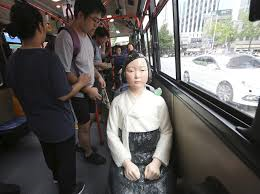
I heard a news story on NPR this week about "Peace Statues" in the country of South Korea that has stayed with me.

[NPR.org]

South Korean Peace Statues, according to the NPR journalist Elise Hu are:

Small bronze figure[s] depict[ing] a girl sitting in a chair, staring straight ahead with a look of determination. She has cropped hair and wears a hanbok — a traditional Korean dress. She's barefoot. Her fist is clenched. Next to her is an empty chair.

The girl memorializes women like Ahn Jeom-sun. She's now 89 and says she has visited the statue often. It symbolizes the youth she lost at age 13, when the Japanese Imperial Army abducted her from her village...The United Nations estimates 200,000 girls and women — mostly Koreans — were seized from villages to join Japan's military sexual slavery program before and during the Second World War...

She and the others came to be known as 'comfort women.' They served at temporary brothels near the front lines — often tents or wooden shacks surrounded by barbed wire — and were forced to have sex with as many as 70 men per day.

According to the news story, the Japanese government would like all of these statues to be taken down.

One could only guess the reasons for this.

Shame.

Guilt.

Denial.

Anger.

A combination of all 4.

And here's the really strange thing, I get it.

Whether it is an individual, a family, a community or a country, to have your ugliest parts out there for everyone to see is extremely painful.

Because to be willing to take a long, hard look at the worst aspects of our own humanity can feel like torture because it forces us to say publicly: This Too.

It forces us to say, I am this, and I am also that, and this forces us to engage in hardcore complexity.

Unfortunately though, those who are feeling vulnerable and exposed because their ugly imperfections and perpetrations of violence have become visible to the world, do not talk about their shame, guilt, denial, and anger.

No, instead they take the offensive.  They attack the victim, and say things like:

Why can't you let it go?

Why do you have to keep bringing up the past?

It wasn't really that bad.

And sometimes, brutally, they might even say:

It didn't really happen that way. Or worse: That didn't happen.

When I was home sick from work recently, I watched the 2014 film depiction of the 1993 Newbery Award winning young adult novel The Giver.


For those of you who are not familiar with the movie or the book, it is a cautionary story about a community that has made the decision to eliminate any and all visible aspects of human suffering from the lives and memories of its community members. 

They do this by:

-naming words like death and murder as "releasing to elsewhere,"

-forcing every individual to get an injection each day that anesthetizes their entire emotional landscape, and

-eliminating and eradicating all painful (and ugly) memories of past horrors like war and human conflict for everyone except only two people in the community called The Giver and The Receiver.

And the consequence of these decisions is a community of human beings who do not grow in wisdom and compassion, which only then perpetuates more suffering a violence in future generations.

I thought about the message of this film and novel this week as I listened to the NPR news story about the kidnapping and mass rape of hundreds of thousands of girls and women. 

I also thought about all of the women, men, boys, and girls who I have known in my personal life and my professional life, who have never been validated in their experience of violation, pain and suffering.

In fact, I thought about all of the invalidation they have received with those very same cruel statements:

Why can't you let it go?

Why do you have to keep bringing up the past?

It wasn't really that bad.

And sometimes, brutally, they might even say:

It didn't really happen that way. Or worse: That didn't happen.

It also made me wonder what it would be like to see the equivalent of the South Korean Peace Statues in this country in relation to:

-our history of genocide of millions of Native Americans,
-our history of slavery of African Americans,
-our history of oppression, sexual violence and maltreatment of females, and
-our history of complete disenfranchisement of the LGBTQ population?

Similar to the South Korean Peace Statue that could be in places as ordinary as the city bus,


what would it be like to see a statue of a black man underneath a tree in Central Park that was a physical reminder of our American history of lynching?

Would it make us pause? Look? Cry? Remember? Grieve?  Grow in wisdom and compassion?

Over the years I've begun to think of forgiveness as a composite process or action, as opposed to a singular action.

Similar to hurt, which I think of as a composite of sadness, anger and disappointment, I've come to think of forgiveness as a 5 Step Process including:

Suffering + Radical Acknowledgement + Grief + Wisdom + Compassion,

and I can very clearly see the role of statues, memorials, art work, songs, plays and holidays to aid in this 5 Step Process when the suffering or violence has been on community, national or international level.

It is an honest, elegant and concrete way of saying This Too- as many times as we need to.

And that is a good start.